First Settlers
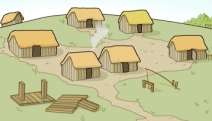
The people who first settled in Dawlish lived on the higher grounds such as Haldon. These were fishermen and salt makers who would venture down to the coast to net fish and gather salt. Salt was abundant in rock pools at the time but resources would have been limited. So eventually salterns were constructed to dry out saltwater or brine and produce salt. Salterns are clay huts with a hole in the roof to allow smoke to escape. Large fires are lit beneath clay troughs of brine to evapourate water leaving salt crystals. Seawater would not have been used in salterns, but rather, brine produced by passing fresh water over salt-rich sand collected from beneath the sea and packed into clay troughs. The high-quality salt produced was stored in sheds or saltcellars. Dawlish produced less salt than its neighbour Teignmough, most likey due to inhabitants being wary of Dawlish Water and its unpredictability when it came to flooding: Floods could easily wash a man out to sea, although there are no recordings of this. There are recordings in the early 19th century of 2 ponies being washed out to sea however.
Dawlish at the time was spelt 'Deawlisc', a Celtic (Brythonic) word meaning 'Devil Water'. Several other spellings and meanings are found later in the Doomsday Book and in documents from Exeter Cathedral. (An alternative meaning, proposed on Wikipedia, is "black stream", cognate with Welsh du (g)lais).
Salt making would have started before Roman times (55 BC) and continued until the withdrawal of the Romans in 400AD. Sometime during the Anglo-Saxon period (400 - 1000AD) salt making in Dawlish ceased, however Teignmouth continued its production. During the Anglo-Saxon period the number of inhabitants grew and some communities settled in the upper part of the valley where floods were less common and the land was fertile. Evidence of early farming settlements is found at Aller Farm, Smallacombe, Lidewell and Higher and Lower Southwood.
Our Genealogy
When the Romans invaded Britain, the Celts of Devon and Cornwall, like Scotland, were left alone and continued to occupy the land throughout the Roman period that lasted until the Anglo-Saxons arrived. The Anglo-Saxons were more interested in trading than conquering and mixed with the Celts of Devon and Cornwall. The majority of local people would have descended from these.
The Danish invasion of 800AD left Dawlish untouched, possibly due to the shallow sea waters and marshland that suggested there was probably nothing worth looting here. Bishopsteignton (near Teignmouth) was destroyed by the Danes in 1001, along with settlements at the mouth of the River Teign.